
Another year has passed, and it is time for my yearly predictions. As you can see from the title, I decided not to review the last year and go over my previous predictions. I always felt a bit weird reviewing myself, and I leave it to you to judge my last year’s predictions. There is one thing, however, that we have to talk about; For the last 10 years, I predicted a weak form of AGI for 2025. Back when I went to school, this was mostly based on predictions from other futurists and following Moore’s law to the point of human-level computing power. In recent years, I kept this timeline since I still believed that current trends could be used to construct systems that appear at first glance as general and capable as a human. So, did we reach this point in 2025? In my (biased) opinion: Yes! There is a significant asterisk, though. As I said, I strictly split between weak AGI and strong AGI. The systems that we currently have reach the former, but are far from the latter. To recapitulate my definitions: weak AGI is a system that can be constructed from multiple subsystems that are able to perform a wide range of tasks, which are, on average, at a human level. Strong AGI is a unified ML model that is able to continuously learn and is able to reach at least a human level on all cognitive tasks, either by imitating or self learning. Current systems based on frontier models like Gemini 3, Veo, and Genie are able to be combined into larger systems using extensive scaffolding that covers a wide range of tasks where they perform superhumanly on some (language understanding, factual knowledge, etc) while being subhuman on others. You could argue that this system is still no weak AGI depending on the number of tasks it is able to perform, but I think it is easy to see that you could take any of the current systems and extend them to perform a given number of extra tasks by attaching more tools or more models (imagine something like giving it access to Stockfish to play superhuman chess). So now that we have got this out of the way, how is 2026 going to look like now that we have weak AGI available?
AI
Most labs will continue training LLM-based systems that compete with DeepMind. I do not believe that anyone is going to overtake them. I always believed in GDM as the lab that would reach AGI first, and now that they have the lead, they will keep it. OpenAI will focus more on tools and products that they can sell, like better audio models for more engaging conversations and agent tools. We will get more and more tools and services that use many more tokens and cost much more, now that the models are capable enough to do valuable work. At the same time, the price per token will stay the same because the models are getting bigger. With the start of 2026, we transition from the billion to the trillion parameter era of Models. We already had a few frontier models that had more than a trillion parameters in 2025, but in 2026, every relevant AI lab will have a trillion-parameter model. That being said, there will be no model with more than 12 trillion. Architectures will keep the core Transformer and optimize parts like Gated delta-nets, new optimizer, better loss functions, multi-token-prediction, etc. The most interesting change could be a change in reasoning from external thinking in tokens to internal, continuous thinking. Post-training will change the most with more extensive RL, new RL algorithms, and more modalities. Robots will make great leaps by combining pre-trained models like LLMs and world models with robotics systems. A big focus will be on continuous learning. Most experts agree that it is fundamentally missing in current Models and needed for AGI. The top research labs will focus on that and develop new ideas to solve this. We will see some early prototypes and ideas in 2026, but continuous learning will not be solved until at least 2027. But even without continuous learning, the time horizons of agents will improve, and their economic value will grow. The METR Benchmark will likly hit tasks with a horizon over a day, and ARC-AGI 2 will be fully solved. ARC-AGI 3 however will not be beaten by the end of 2026.

Open standards like MCP and agent skills help with rapid adoption, and this will lead to more layoffs, especially in countries with weak worker protection, like the USA. Open Source will continue to trail behind the frontier by about 6-9 months. These open models will mostly come from China. Mistral is falling behind, and Meta will likely stop open-sourcing their top models. Nvidia is the last source of open-weights models, but they will limit their releases to not compete with their customers.
Hardware
The hardware landscape in 2026 is defined by bifurcation: massive scale for training and specialized efficiency for inference. Nvidia remains the king, but its monopoly is showing cracks in the inference market.
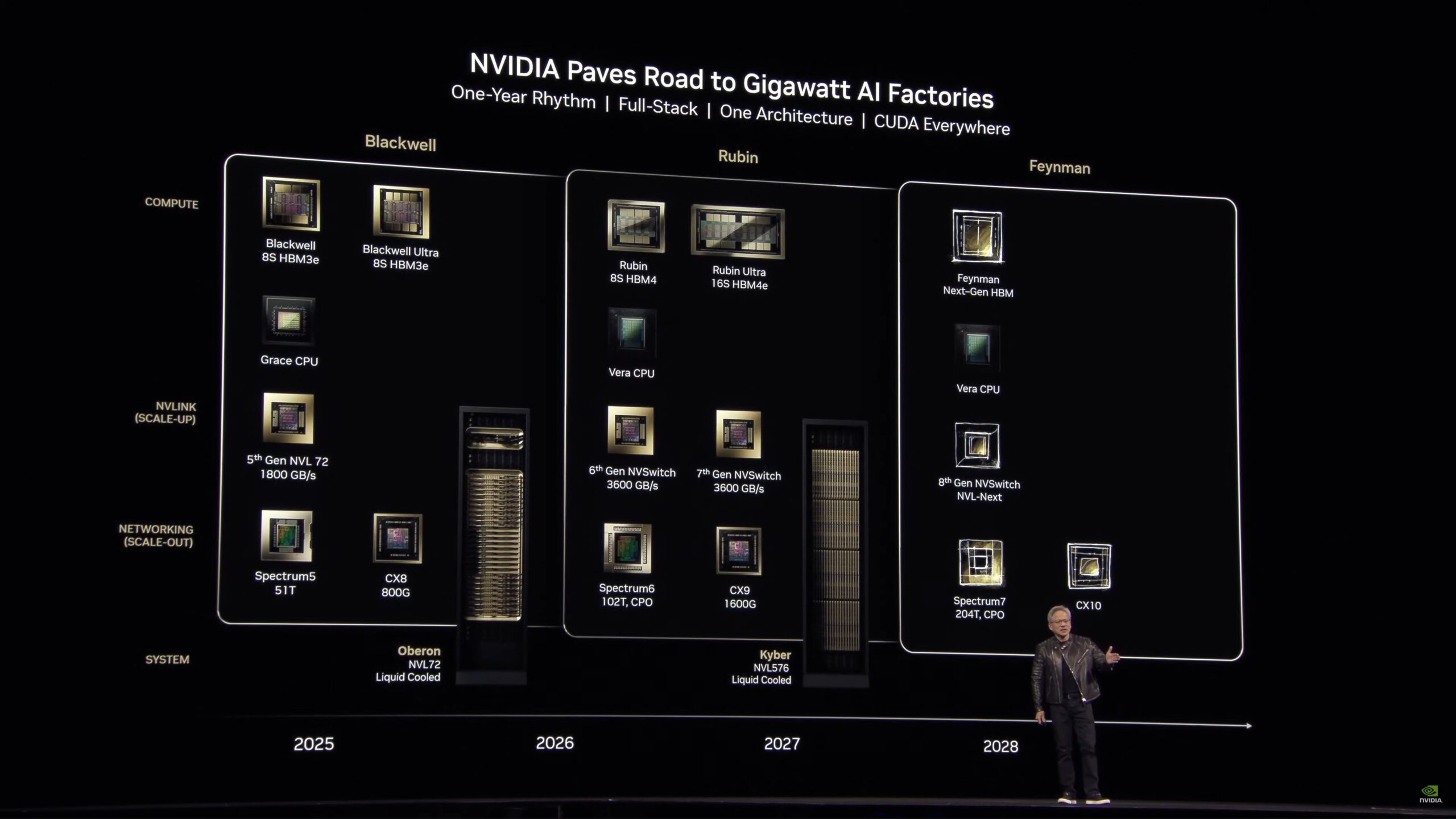
- Training: Blackwell will dominate training compute for the entirety of 2026 until Rubin is ready. Most top labs will have at least one Gigawatt datacenter for training in 2026. China will use less and less Nvidia hardware at the end of 2026 and fully transition to domestic chips in 2027. The disadvantage of bigger nodes can be compensated for with cheaper chips and energy.
- Inference: This is where the innovation is happening. We will see more competition for Nvidia until Rubin is released at the end of the year. When it is finally getting deployed at scale in 2027, it will drive the price of “reasoning” down massively. There are a few growing ASICs for inference, including Cerebras and Groq (After writing this, Nvidia basically acquired Groq), that use SRAM instead of DRAM, which fill a niche and are not bottlenecked by the DRAM supply. It is very likely that the average Inference provider will use multiple different architectures for different parts of the inference pipeline. SRAM chips with very high bandwidth would be the last piece for very fast reasoning. OpenAI’s ASIC will use DRAM.
- Consumer: AI hardware for end users is struggling. The high DRAM prices are expected to persist until 2027, making AI hardware too expensive for end users. Instead, most users will continue to use APIs either directly or through subscriptions. OpenAI is expected to release its first AI device in the second half of 2026. It will focus on audio as an interface. This follows the current trend of moving AI closer to the user: PC → Smartphone → Wearables.
- Quantum computer: Quantum computers are improving quickly. 2026 will see the first quantum computer with thousands of qubits. This is close to an usable amount to do interesting stuff. This will lead to more public interest and fear about encryption. I expect the first cybersecurity case involving Quantum computers to happen in 2027 or early 2028. We might only hear about it much later since it is likely that the first users of quantum computers for this purpose will be states, especially the US and China. Besides encryption, the main target market for quantum computing companies will be material and physics simulations. There is a high chance that we will get some research breakthroughs by 2030 that are going to be only possible with quantum computers.
- New computing platforms: The current demand for more flops is fueling the development of new approaches. Especially, photonic computing is promising due to energy efficiency and speed. 2026 will have multiple companies trying to market different new platforms, but I do not expect a commercial breakthrough before 2027. Their success depends heavily on how well they are able to use the current infrastructure. Chips that can be produced with normal lithography machines have a huge advantage over new chips that require new custom tools to build them. The same goes for material availability, which is becoming more critical with the rise of trade wars.
Robots
If 2025 was the year of the Humanoid Robot announcements, 2026 is the year of production. We are not going to see robots walking our dogs just yet, but if you work in a large-scale warehouse or a car factory, you will see them working next to you. The software is finally catching up to the hardware. End-to-end neural networks for control are becoming the norm, allowing robots to learn from video data rather than manual code. China is going to lead this wave. Not because they have the best robots or software, but because they are the only ones that can produce robots at scale cheaply enough. There are a lot of humanoids, but in 2026, only a few companies worldwide will scale to more than 10000 units.
The ones that do will have the price advantage. No useful humanoid will be under 15000$ (I exclude the small unitree ones because of limited usefulness). The biggest hardware limitation will be the limited battery time, which leads to nearly 50% downtime. While China is leading production, large AI labs will focus more onto robotics either by buying hardware startups, partnering, or building out their own robot divisions. The 3 main players here will be OpenAI, DeepMind, and Nvidia. All of them will quickly overtake Chinese startups in software by using large general models. Imagine something like Gemini 3.5 robotics. So at the end of 2026, we will have a few very expensive and general robots in the US, and a bunch of cheap mass-produced robots from China that are less general. 2027 will combine the two and start the automation of physical work.

Energy
The energy crisis I hinted at in 2024 is here. AI data centers are now competing directly with cities for power. In 2026, we will see more “off-grid” data centers that are co-located exclusively with their own power sources, bypassing the national grids entirely.
Solar continues its exponential march, but the storage problem remains the bottleneck. Especially the transition to perovskite panels will enable solar to reach 30% efficiency, beating current panels by over 20%. Battery technology is improving, with solid-state batteries finally appearing in premium EVs and consumer tools, but grid-scale storage is lagging. This will change in 2026. Grid storage will increase a lot and make electricity much cheaper in Europe. Renewables are gaining massively and will continue outpacing predictions despite the rise of right-wing populist parties that try to counteract the progress. Current predictions think that solar and wind can hit 6000 TWh in 2026. I think we will go over 6100TWh. Depending on the next US election, we have a chance to hit 50% renewables by 2030.
Fusion is still in the “promising” phase. We are going to see a net-energy gain record broken this year, but commercial electricity from fusion is still a year or two away. I personally do not think Fusion will become a relevant part of the energy mix anytime soon because of the costs of building and the long construction time.
Science
This is the area I am most optimistic about. The “Weak AGI” systems we have now are finally useful for scientists. In 2026, we will see rapid progress in multiple areas:
- Materials: Material science is a big focus, since it is valuable and a good target for systems like Alphafold. Material models will emerge in 2026 and be used for key breakthroughs like Superconductors, Battery materials, and to find replacements for geopolitical sensitive materials like Neodymium.
- Longevity/Medicine: The longevity movement is hitting the mainstream. It’s no longer just for tech billionaires. We will see the first FDA trials approved for drugs that explicitly target “aging markers” rather than specific diseases. My prediction about the first 200-year-old human being alive is on track. Besides AI systems for drug discovery, bio simulations will also start to play a larger role. Simulating the effect of new medicine on the human body will lead to speedups in medical research.
- Mathematics: This area is completely overlooked. The combination of next-gen LLMs and software solutions built around LEAN will allow rapid progress in mathematics. 2026 will likely yield at least 2-3 major breakthroughs, primarily driven by AI systems. In the medium term, progress in mathematics also means progress in related sciences like physics. The ripple effects will take a few years, but the overall speedup in fundamental research will be apparent in a few years.
- Physics: Similar to mathematics, AI can be broadly applied to physics. Besides the broad benefit of next-gen LLMs, more specialized models like the ones used in biology can also be developed to solve specific physics problems, like Fusion reactors.
VR / AR
Augmented Reality is finally taking off. The smart glasses released this year are reaching a capability threshold. They aren’t replacing phones yet, and they will not in the near future, but they will become the primary interface for AI assistants. The ability for the AI to “see” what you see is essential. Apple will enter the market for AR either by the end of 2026 or in 2027. This will mark the start of the mainstream adoption of smart glasses.
VR remains a niche for gaming and simulation. The “Metaverse” as a social hang-out space is not going to be a thing until the hardware is way better and cheaper. Progress on VR hardware will not stop in 2026. Eye tracking is becoming standard, and low-energy SoCs are becoming much more useful for standalone headsets. The next Apple VR headset will be a good example of the difference in performance.
Transportation
Self-driving cars are boring now, which is good. Waymo and competitors operate seamlessly in most major US cities. In 2026, the areas will grow and extend to Europe and Asia. The critical point is pricing. Towards the end of the decade, the price will be low enough to underbid Uber and other services and make them much more popular. Electric cars in general will take the lead and solve all the remaining problems, like charging time and range, when battery technology improves in 2026 and 2027. By 2030, electric cars will be superior in every aspect.
Geopolitics
Humanity is at another breaking point. Geopolitical tension is at Cold War levels. China – Taiwan, Russia – Europe, US – Venezuela, Japan – China, US – China, and so on. These conflicts are fueled by a fundamental fear of falling behind in an ever-accelerating race. Energy and resource independence and control over information are drivers of this growing fear. To make a few specific predictions about potential conflicts:
- 5% chance for a Russia-Europe War in 2026, 20% till 2027, 50% till 2030.
- In case of a Russian attack: 90% that it will include Russian occupations.
- China invades Taiwan in 2026: 5%, till 2026: 10%, till 2030: 40%
- In case of a Taiwan attack: 90% US Involvement, 50% escalation to China – US Pacific War, 40% larger involvement of Japan
- There is a 5% chance of the use of a nuclear weapon until 2030.
- 60% chance for a larger US military operation till 2027.
- 50% chance that the Ukraine war will not end in 2026.
- 0% chance that Israel will stop attacking neighboring countries in 2026.
Society
The societal impact of the trends described above will be uneven and, in many cases, destabilizing. An important factor is the growing gap between technological capability and institutional adaptation. Governments, legal systems, and social norms are moving far too slowly to keep up with AI-driven change. The same goes for humans themselves, who are more and more overwhelmed with the complex digital world and react by going back to simpler realities though populism.
The public opinion on AI will continue to get worse due to the effects on the job market and the digital life. Education systems will struggle. While AI tutors and personalized learning systems will become widely available, formal education has to learn to handle them and change its approaches to adapt to AI.
Information ecosystems will further fragment. AI-generated content will be ubiquitous, cheap, and convincing. Trust will continue to erode—not only trust in media, but also trust in institutions and expertise. The response will not be a return to shared truth, but rather a retreat into smaller, more insulated belief systems. Regulation will be discussed extensively, but effective enforcement will remain limited. This is partially because of the fear of falling behind in AI. In areas where it is not possible to retreat into smaller bubbles, misinformation will cause even more damage than they did in 2025. Current trends like lack of trust in vaccines, climate change, and other established scientific facts will accelerate and damage our society.
Economics
The global economy is under a heavy downward trend because of the growing tensions and the effects of climate change. The main upward trend is the current AI progress. There is almost certainly a crash coming when some of the less dominant AI players fail to turn a profit, and Investors lose confidence. I am not sure what the consequences of this crash will be, and if it will lead to a global recession or just a correction. This also depends on how fast AI can be applied to actual, valuable economic work. Since most of the money came from the big tech companies there is a chance that they can take the loss and the global impact is quite small. There is a big current overhead of model capabilities that can be used to automate work, but are not yet. I expect China to profit from more automation and their growing energy production, the US to be very volatile, and the EU to fail to gain relevance in AI, but profit from their early investments in renewable energy.
Conclusion
2026 could become the beginning of a new epoch in human history. The post-WW2 American-centric world order is not collapsing overnight, but it is clearly eroding. Technological leadership, manufacturing capacity, energy independence, and demographic trends are pulling the world toward a more multipolar and unstable equilibrium. AI accelerates all of this by compressing timelines and amplifying existing advantages.
There is an optimistic reading of 2026: accelerated scientific discovery, rapid progress on climate mitigation, improved medicine, and the first real steps toward automating dangerous or undesirable labor. There is also a pessimistic one: increased inequality, geopolitical escalation, fragile institutions, and a growing sense that human agency is being diluted by systems no one fully understands or controls.
Both readings are valid. The defining feature of 2026 will be that humanity is forced to hold them at the same time. The coming years will not be about whether we can build more powerful systems, but whether our social, political, and economic structures can adapt fast enough to survive them. I hope so, and I am looking forward to writing more in 2026 and continuing to work on AI myself. After all, the best way to make the future better is to work on it yourself.
Leave a Reply